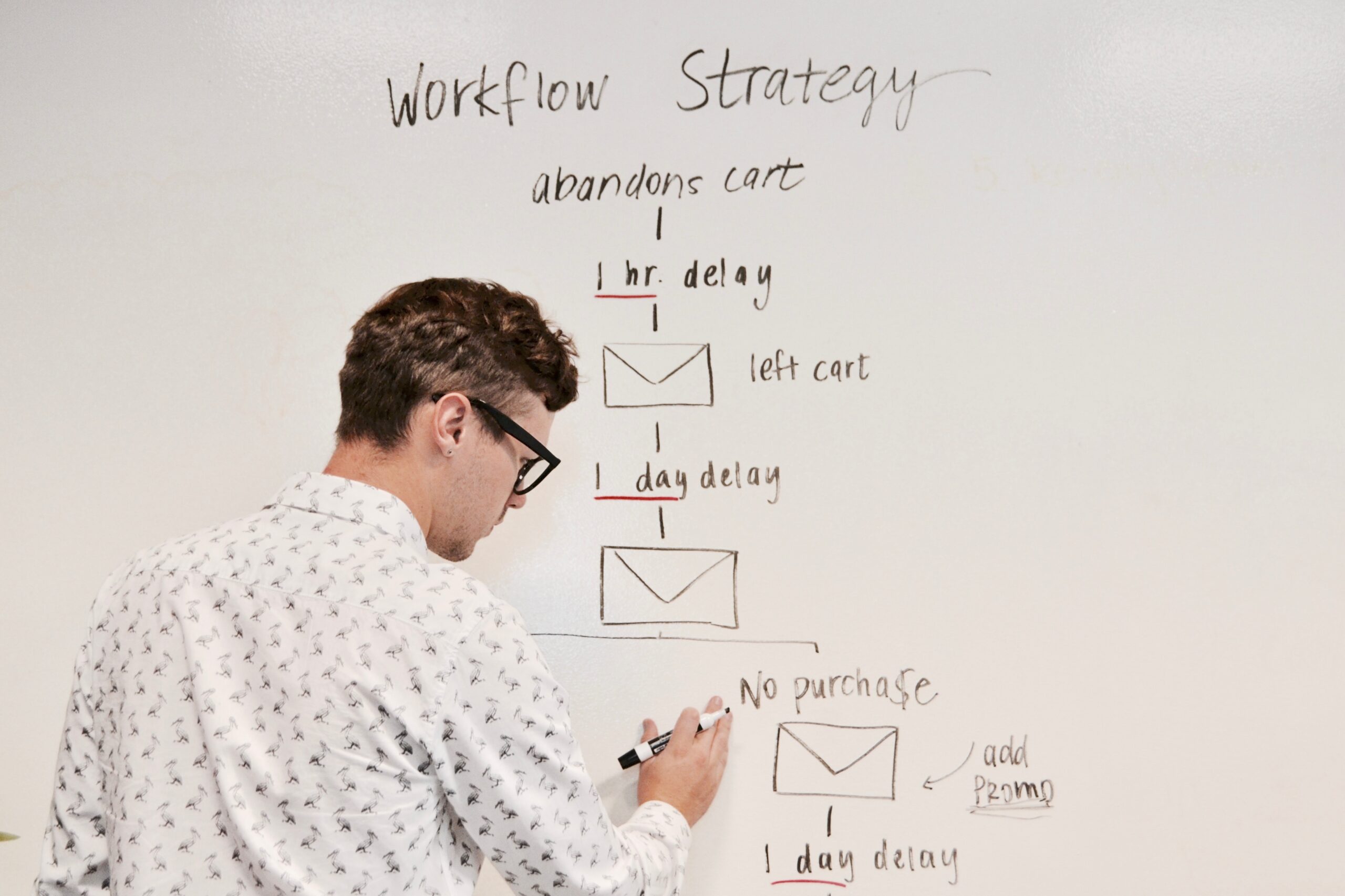

Workflow architecture design defines how work moves through a business: the stages a job follows, who owns each stage, what information passes between teams, and who can make decisions. In a project-based business, it connects enquiry, survey, quotation, delivery and payment. Once the stages are agreed, a Kanban board can show each job’s position in the workflow.
A heat pump retrofit, a commercial ventilation package and a solar PV and battery storage installation each pass through those stages at their own speed, with different information and people involved at each one. Where the route is designed, work can move without the owner pushing it. Where it has simply grown, jobs wait in inboxes, information is lost between stages, and decisions queue up at the owner’s desk.
This post explains how workflow architecture applies to project-based businesses such as Heating, Ventilation and Air Conditioning (HVAC), Electrical Contracting and renewables, and why an operating partner treats it as the place to start.
What is workflow architecture design?
The term is also used in software, where “workflow architecture” describes how an automation platform or workflow engine is built. That is a different subject. In an operating business, the architecture is the structure of the work itself. Software can support it, but it cannot decide it.
The five parts of a workflow architecture
A workflow architecture has five parts:
- Stages. The steps a job passes through, from enquiry to cash received.
- Hand-offs. The points where responsibility passes from one person or team to another, such as from the surveyor to the estimator, from the office to a subcontractor, or from the installation team back to the office.
- Information. What each stage needs to receive in order to start, and what it must pass on when it finishes.
- Decision rights. Who can approve a price, a variation, a change to the programme or a purchase, without referring it upwards.
- Rhythm and measures. The regular reviews and the small set of numbers that show whether work is flowing or stuck.
Process maps help describe individual workflows. Workflow architecture connects those workflows and establishes the responsibilities, information and controls that make them work together. Once the stages are designed, measuring workflow efficiency shows how smoothly jobs actually move through them, from lead times to queues and bottlenecks.
Why workflow architecture matters in a project-based business
A project-based business can standardise and improve its repeatable processes, such as surveys, quotations and commissioning checks. Its challenge is accommodating variation within that structure: different job sizes, customers, suppliers and site conditions, all moving through the same office. The methods for improving one process at a time, from mapping and root cause analysis to standardised work, are set out in these business process improvement strategies.
That variation creates hand-offs, and hand-offs are where work can slow down. A survey that leaves out the details the estimator needs means a second visit. A quote that does not record what was promised means a dispute at handover. A completed job that nobody tells the office about means a late invoice.
As a business grows, the number of jobs in progress rises faster than anyone’s ability to hold them in their head. That is why growth can make a business harder to run before it makes it easier.
Time limits set by schemes and regulations
Some time limits are set outside the business. Under the Boiler Upgrade Scheme in England and Wales, Ofgem’s installer guidance gives each voucher a validity period, three months for air source heat pumps and biomass boilers and six months for ground source heat pumps, and the installer has to commission the system and submit the voucher redemption application within that period: finishing the installation is not enough on its own. For notifiable electrical work in a home in England, the Planning Portal explains that a registered electrician arranges for the customer to receive a Building Regulations compliance certificate within 30 days. Rules like these change, so they need checking at the time. The workflow point is that each of these time limits needs a named owner, rather than relying on someone remembering.
Enquiry to cash: the seven stages of a project workflow
The stages vary by trade, but the spine of a project workflow looks like this:
- Enquiry and qualification. Deciding which enquiries are worth a survey.
- Survey and design. Collecting the site information and producing the design, such as a heat loss calculation for a heat pump, a ventilation layout or a PV and battery system design.
- Estimating and quotation. Pricing the work, including labour, materials, access and risk.
- Order and planning. Confirming the order, buying materials and booking the installation team or subcontractors.
- Installation. Carrying out the work on site.
- Commissioning and certification. Testing, commissioning and issuing the certificates the trade or scheme requires.
- Handover, invoice and payment. Handing over to the customer, invoicing and collecting payment.

Wherever the job passes from one person or team to another, that move is a hand-off. The design questions are the same at every one of them: who owns the job, what information must travel with it, what “ready” means, and what happens when something is missing.
Worked example: the survey-to-estimating hand-off
Take the hand-off from survey to estimating on a heat pump retrofit.
- Who owns it. The surveyor owns the job until the estimator accepts the survey pack, within an agreed time. From that point, the estimator owns it.
- What information is required. Room measurements and heat loss data (or the completed calculation, where the surveyor also designs), existing radiators and pipework, hot water use, the electrical supply, main fuse and consumer unit, proposed positions for the outdoor unit and cylinder with any noise or planning constraints, access and parking, photographs, the customer’s requirements, and any scheme eligibility checks the job depends on.
- What makes it ready. Every item on the survey checklist is complete, and the estimator has accepted the pack in the job system.
- What happens when information is missing. The pack goes back to the surveyor with the gap named, rather than the estimator guessing or ringing the customer. The job shows as waiting for survey information, so the delay is visible and counted.
The same four questions work for every other hand-off, such as quotation to order, or handover to invoice.
The last of those deserves particular attention. The time between a job being finished and the invoice being raised, and then paid, decides how much cash the business has to fund the next job. The quote to cash flow gap explains how small delays along this chain add up to a business that is profitable on paper and short of cash in the bank.
Check your business: hand-offs from enquiry to cash
- Could someone in the office say which stage every live job is at, without asking the owner?
- Is there a set list of information that travels with each job at every hand-off, such as what a survey must give the estimator?
- Is it known how many days pass between a job being finished and the invoice going out?
How to design a workflow architecture in six steps
Workflow design starts from the work that already happens, not from a blank page. The design moves through six steps.
Map the current route. Follow a handful of recent jobs from enquiry to payment and record every stage, hand-off and wait. A swimlane diagram, with one lane per role, shows where work crosses between people. Value stream mapping adds lead time, showing how much of a job’s total time adds value and how much is spent waiting.
Find the queues. The map separates slow work from waiting work: quotes waiting for approval, orders waiting for a price, invoices waiting for a completion note. Waiting work can be reduced without changing how the work itself is done, and the queues show where the design needs to change.
Set decision rights. Write down who can decide what, and up to what value. Pricing, variations, purchasing and changes to the programme are the decisions to settle first, because each one stops a job until someone with authority answers.
Define what each stage needs. For every hand-off, set out the minimum information that must travel with the job, as in the survey example above.
Build the rhythm. Agree the weekly and monthly meetings that review the workflow, and a small set of measures, such as time from enquiry to quote, quote conversion, jobs on hold, and days from completion to invoice.
Write it down and test it. Record the agreed workflow in an operations manual that the team uses day to day, try it on one type of job first, and adjust before rolling it out.
Why an operating partner starts with the workflow
An operating partner works with the owner, the management team or the investors on how the business runs, with a mandate to make it more valuable. The workflow is where that work starts because it is where time, margin and cash can be gained or lost.
Margin can be lost at the hand-offs, in a survey that missed something or a variation that was never priced, and cash is held up when a finished job sits for a fortnight before anyone invoices it. Owner time is spent at the same points, answering questions that a clear workflow would have answered already. Changing the workflow changes both.
The Office for National Statistics reports, in its latest release on management practices (May 2024), that firms’ overall management practice scores, which cover continuous improvement, key performance indicators, targets and employment practices, are statistically significantly related to productivity. The survey covers firms with at least ten employees, and the result is a correlation, so on its own it does not show cause and effect. It supports structured management in general; it does not measure workflow architecture or operating partners directly.
The work overlaps with a fractional COO’s; the difference is in the engagement, meaning who appoints the role, who it answers to and what it is measured on. Who appoints each role and who it answers to, and how the role works when an investor appoints it, is set out in what a private equity operating partner does.
Check your business: measures and decisions
- Is a small set of measures and targets reviewed at a regular meeting?
- Could lost margin on the last few jobs be traced to a particular stage or hand-off?
- Are pricing, variations and purchasing decided without waiting for the owner?
Where automation and AI fit in the workflow
Automation speeds up whatever workflow it is given. A clear workflow becomes faster; an unclear one can produce the same confusion more quickly and with less visibility. That is why automation comes after the workflow has been designed, not before. Which back-office workflows suit AI tools, and how to pilot them with a person checking each output, is covered in the guide to AI workflow automation.
Once stages, hand-offs and decision rights are agreed, automation can take on the repetitive parts: creating a job record from an accepted quote, sending reminders before a voucher or certificate deadline, or raising an invoice when commissioning is signed off.
The newest step is agentic AI, where software is given a goal and chooses its own steps. What AI agents are and how they work explains why the workflow needs to be clear before an agent is used.
Workflow architecture and business value: what a buyer looks at
A buyer of a project-based business is buying its ability to win, deliver and get paid for work after the sale. If that ability depends on the owner directing every job, it is harder to transfer to a new owner. If it sits in a documented workflow that the team runs, with decision rights and measures that work without the owner, it transfers with the business.
That is why workflow architecture sits underneath value as well as day-to-day efficiency. Alongside the financial and legal work, a buyer’s due diligence looks at many of the same things a workflow review does: who makes decisions, how jobs are tracked, how quickly work turns into cash, and how much depends on one person. What UK buyers look for in an HVAC business sets this out for one sector; the same questions apply to Electrical Contracting and renewables businesses.
Where a workflow review starts
When jobs keep coming back to the owner for decisions, a workflow review can start with the hand-offs from enquiry to payment. Tracing three recent jobs, and noting every point where each waited, every piece of information that had to be chased and every decision that went to the owner, shows which hand-offs lack an owner, a checklist or a decision right.
Frequently asked questions
A process map describes one workflow. Workflow architecture connects the workflows across the business and sets the responsibilities, information and controls that make them work together. A business can have many process maps and still have no designed workflow architecture.
Workflow software records and automates work. Workflow architecture decides how the work should move in the first place: the stages, who owns each one and who decides what. Software built on a workflow that has not been designed can carry the existing problems into a new system.
A hand-off is a point where responsibility for a job passes from one person or team to another, such as from surveyor to estimator, or from the installation team to the office for invoicing. Each hand-off needs a clear owner and a defined set of information, or the job waits while someone chases it.
Measures that track flow rather than effort show this, such as time from enquiry to quote, quote conversion, the number of jobs on hold and days from completion to invoice. Reviewed in a regular meeting, they show where work is queuing before it shows up in the accounts.
An operating partner maps how work currently moves, agrees the design with the owner and team, sets decision rights and an operating rhythm, and stays involved while the new workflow is embedded. The aim is a business that runs without the owner directing every job, which a buyer can also take into account.
Sources
- Office for National Statistics: Management practices in the UK: 2016 to 2023 (May 2024, corrected July 2024)
- Ofgem: Boiler Upgrade Scheme: Guidance for Installers, version 5.1 (July 2026)
- Planning Portal: Electrics: Building Regulations, checking for safety
Figures last checked: October 2026