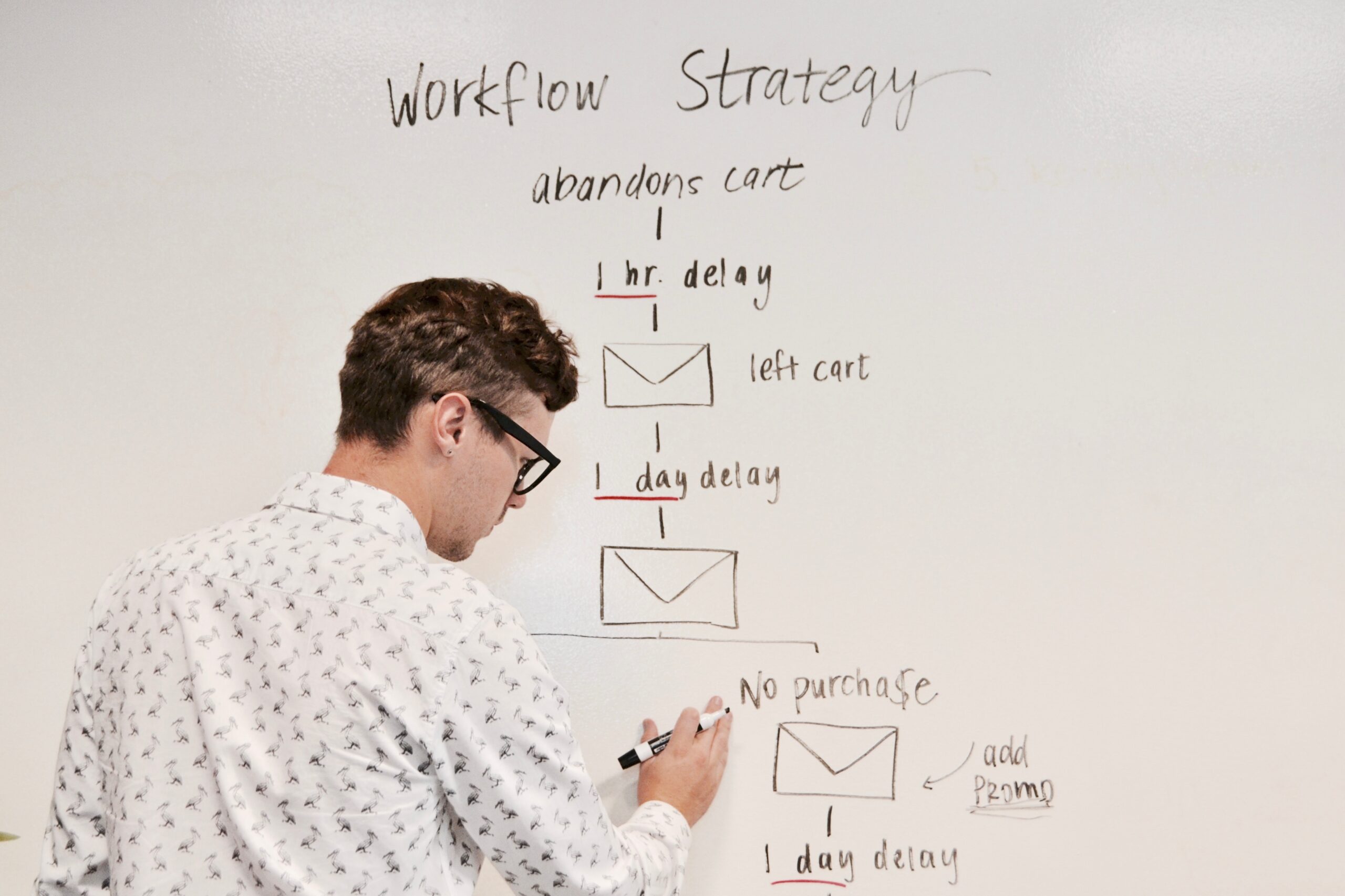
An HVAC company’s office runs the same routines every week and every month: chasing invoices, following up quotes, checking records and certificates, and preparing returns before their deadlines. AI workflow automation is the use of AI inside a routine business process to read, sort, draft or check information, with a person approving anything that matters.
This guide works through six AI workflow automation examples from the back office of a heating, ventilation and air conditioning company: credit control, quote follow-up, F gas records, Boiler Upgrade Scheme paperwork, the monthly CIS return and job margin. Each example is set out in the same six parts, ending with what has to be true before it is built, so they can be compared. Credit control, quote follow-up, the CIS return and job margin work the same way in electrical contracting and renewables companies; the F gas and Boiler Upgrade Scheme examples apply wherever heat pumps or other refrigerant-based equipment are installed or serviced. The wider picture of what AI workflow automation is, and how it differs from rule-based automation, is covered in what AI workflow automation is and where it fits.
What does an AI workflow automation example look like in an HVAC company?
An AI workflow automation example in an HVAC company has six parts: a trigger that starts it, a system that already holds the data, an AI step that reads, sorts or drafts, a named person who approves the output, a measure that shows whether it helped, and what has to be true before it is built. If any part is missing, the job is not yet ready to automate.
Every example below uses the same six parts. For credit control, they look like this.
| Part | What it means | Credit control example |
|---|---|---|
| Trigger | The event or time that starts the job | Each morning at 8am |
| Data | The system that already holds the information | The accounts package’s aged debt report |
| AI step | What the AI reads, sorts, drafts or checks | Drafts a reminder for each overdue invoice |
| Approval | The named person who checks before anything is sent | The credit controller |
| Measure | The figure that shows whether it is working | Days from due date to first reminder |
| Has to be true first | What must be in place before the automation is built | Agreed payment terms and one place to record disputes |
The approval part is what separates these examples from software left to run on its own. A useful rule for drawing the approval line is automate the chase, not the judgement: the AI prepares the reminder, the list or the check, and a person makes any decision about money, compliance or a customer.
None of the examples involves work on site. They are office routines, which is where the data already sits in a system and where a mistake can be caught at a desk before anything leaves the business.
How can AI workflow automation help with credit control?
AI workflow automation can help with credit control by producing a daily list of overdue invoices from the accounts system and drafting a reminder for each one, in the right tone for how late it is. The credit controller reads the drafts, edits any that need it and sends them.
- Trigger: each morning, or when an invoice passes its due date.
- Data: the aged debt report and customer contact details in the accounts package.
- AI step: sorts overdue invoices by age and value, drafts a reminder for each, and notes any customer with a dispute or a promise to pay already logged.
- Approval: the credit controller approves every reminder before it is sent.
- Measure: days from due date to first reminder, and debtor days over time.
- Has to be true first: agreed payment terms on every invoice, and one place where disputes and promises to pay are recorded.
Reminders can also refer to the customer’s legal position on late payment. For business-to-business debts, GOV.UK’s guide to late commercial payments sets statutory interest at 8% plus the Bank of England base rate, unless the contract sets a different rate. Whether to claim it is a commercial decision about each customer, which is why it sits on the human side of the approval line.
Credit control is the collection stage of the quote to cash flow process, so gaps earlier in that process, such as invoices raised late, show up here as overdue debt.
How can AI workflow automation follow up quotes that have gone quiet?
AI workflow automation can follow up quotes that have gone quiet by checking the job or CRM system each day for quotes with no reply after a set number of days, and drafting a short follow-up that refers to the specific job. The estimator or sales lead approves each one before it goes.
- Trigger: a quote reaches a set number of days with no reply and no status change.
- Data: quote records in the job management or CRM system, with the customer’s original enquiry.
- AI step: drafts a follow-up that names the job and the quoted option, and flags quotes above a set value for a phone call instead.
- Approval: the estimator or sales lead who owns the quote.
- Measure: share of quotes followed up on time, and quote conversion rate.
- Has to be true first: every quote has a status and an owner in one system, rather than in individual inboxes.
Quiet quotes can be a capacity problem as much as a sales problem: follow-ups slip when the estimator is pricing the next job. The automation takes the remembering off the estimator; the conversation with the customer stays with a person.
How can AI workflow automation keep F gas records and renewals on track?
AI workflow automation can keep F gas records on track by checking each completed service job for the details the records need, and flagging any that are missing before the job is closed. It can also send alerts before company certificates, accreditations and insurances lapse, each to a named owner.
GOV.UK’s guidance on recording F gas in equipment you own or service says records must be kept about equipment that contains F gas equivalent to 5 tonnes or more of carbon dioxide, by those who operate or service it. The records include the type and quantity of gas installed and added, and the dates and results of mandatory leak checks, and must be kept for 5 years.
- Trigger: a service or leak-check job is marked complete; or a certificate, accreditation or insurance is a set number of days from its renewal date.
- Data: job sheets in the field service system, and a register of certificates and renewal dates.
- AI step: reads the job sheet, checks the required fields are filled, and drafts a note to the engineer or office listing anything missing.
- Approval: the compliance owner, who decides whether a job can be closed and makes sure each certificate’s owner renews it.
- Measure: jobs closed with complete records, and renewals missed.
- Has to be true first: a job sheet with fixed fields for the record details, and one register of every certificate with its owner.
The automation checks completeness, not correctness: whether a figure on a job sheet is right is still a matter for the engineer and the compliance owner.
How can AI workflow automation help with Boiler Upgrade Scheme paperwork?
AI workflow automation can help with Boiler Upgrade Scheme paperwork by tracking each voucher against its deadline and checking that the documents needed for redemption are in place. It flags any voucher near expiry and any job with a missing document, so the office can act while there is still time.
Ofgem’s Boiler Upgrade Scheme page for installers puts the application on the installer, who must be certified under the Microgeneration Certification Scheme (MCS) for the technology. From the date the voucher is issued, the installer has 3 months to complete the installation, or 6 months for a ground source heat pump. Redemption follows commissioning and the MCS installation certificate, and Ofgem’s final checks include reviewing the details on that certificate.
- Trigger: a voucher is issued; then weekly until it is redeemed.
- Data: the voucher record, the job’s schedule, and the commissioning and MCS certificate details.
- AI step: calculates days left on each voucher, compares them with the booked installation date, and checks the certificate details against the job record.
- Approval: the person who submits redemption applications.
- Measure: vouchers redeemed before expiry, and time from commissioning to redemption.
- Has to be true first: voucher dates and job dates held in one place, not across emails and spreadsheets.
Scheme rules change, so the dates and conditions the automation checks against need reviewing whenever Ofgem updates its guidance. The full rules are in Ofgem’s Boiler Upgrade Scheme guidance for installers, where version 5.1 was current when this post was last updated. For an installer, the scheme is a funding route for customers, and the paperwork affects how quickly that funding turns into cash.
How can AI workflow automation prepare the monthly CIS return?
AI workflow automation can prepare the monthly Construction Industry Scheme (CIS) return by gathering the month’s subcontractor payments and deductions from the accounts system, checking them against subcontractor records, and listing anything that does not match before the deadline. A person reviews the figures and files the return.
GOV.UK’s guidance for CIS contractors says monthly returns must reach HMRC by the 19th of every month following the last tax month. A return one day late carries a £100 penalty. HMRC’s guide for contractors and subcontractors (CIS 340) adds that the obligation to file a nil return was reinstated for mainstream contractors from 6 April 2026: one that has paid no subcontractors files a nil return or tells HMRC of a period of inactivity.
- Trigger: the end of each tax month, on the 5th.
- Data: subcontractor payments and deductions in the accounts package, and subcontractor details.
- AI step: collates payments and deductions, flags any subcontractor with missing or inconsistent details, and drafts a summary for review.
- Approval: the finance lead, who checks the figures and files the return.
- Measure: returns filed before the 19th, and queries raised after filing.
- Has to be true first: subcontractor invoices coded consistently in the accounts system.
Monthly returns are filed only by contractors, businesses that pay subcontractors for construction work, so this example applies to some HVAC companies and not others.
How can AI workflow automation flag jobs running below target margin?
AI workflow automation can flag jobs running below target margin by comparing each live job’s costs to date with its quoted price every week, and listing the jobs where margin has fallen below a set target. The operations or commercial manager reviews the list and decides what to do about each job.
- Trigger: weekly, after timesheets and purchase invoices are posted.
- Data: quoted value, labour hours and material costs per job in the job management and accounts systems.
- AI step: calculates margin to date per job, flags those below target, and summarises the likely cause from the cost lines, such as extra labour hours or unplanned materials.
- Approval: the operations or commercial manager, who decides whether to raise a variation, adjust the programme or accept the loss.
- Measure: jobs flagged while still live rather than after completion, and margin on completed jobs.
- Has to be true first: labour and materials booked to the right job number every week.
Margin flags are only as good as the job costing behind them. Where hours and materials are booked late or to the wrong job, the first piece of work is the booking routine, which is part of workflow architecture design: agreeing the stages, owners and hand-offs a job moves through.
What makes an HVAC workflow a good first candidate for AI workflow automation?
A good first candidate for automation in an HVAC company is a job where the data is complete in one system, one person owns the task, the job happens every week, and a mistake would be caught at approval without harm. Credit control and quote follow-up can meet all four; margin flags depend on reliable job costing.
| Example | Data often held in one system? | Typical impact if an error is missed at approval | Common thing to fix first |
|---|---|---|---|
| Credit control | Yes, the accounts package | Low | Disputes recorded in one place |
| Quote follow-up | Often, if quotes have statuses | Low | Quote status and owner |
| F gas records and renewals | Partly | Medium | Fixed fields on job sheets |
| Boiler Upgrade Scheme paperwork | Often split across systems | Medium | Voucher and job dates in one place |
| CIS return | Yes, the accounts package | Medium | Consistent invoice coding |
| Job margin flags | Split across job and accounts systems | Low | Timely job costing |
The table is a general guide, not a rating for any particular business: which systems hold what, and how much a missed error would matter, depend on each company’s process.
In Rostone Operating Partners’ work with HVAC companies, chasers and reminders have been among the first jobs to pass these tests, because the data already sits in the accounts or job system and one person already owns the task. Further tests, and a check for whether a workflow is written down well enough to automate, are set out in the companion guide linked in the introduction. Where a task has no agreed routine yet, a written procedure comes first, as covered in the guide to standard operating procedures.
How widely do UK businesses use AI for administration?
UK businesses’ use of AI doubled in a year, with administration the most common area of use, but construction lags behind other sectors. The government’s AI adoption survey report 2026 found 32% of UK businesses using AI, up from 16% in 2025, while the Office for National Statistics puts AI use in construction at 13%.
The AI adoption survey report 2026, published on GOV.UK in October 2026, found that administration was the most common area of use, named by 81% of businesses using or planning to use AI, ahead of marketing and IT. Limited skills, expertise or knowledge affected 67% of businesses that had adopted AI and 78% of those planning to, and many cited the lack of a clear business case. Where cost was a factor, it was more often the time, effort and resource needed than the price of tools. On results, 24% reported lower operating costs, while 64% had seen no immediate financial effect.
The Office for National Statistics article Artificial intelligence in UK businesses: 2023 to 2026 reports 58% of information and communication businesses using AI in June 2026, compared with 13% in construction. The ONS reports construction as a whole, so the figure covers HVAC installers alongside the rest of the sector.
Read together, the figures suggest the barrier is less about access to tools and more about knowing which jobs to start with, which is the question the examples above are meant to answer.
How does a person stay in control of each automation?
A person stays in control of each automation through three habits: nothing is sent, filed or changed without approval; a new automation runs alongside the manual process until its output matches; and each automation has one owner who reviews its mistakes. The automation drafts; the owner decides.
- The approval line. Every example above names who approves. That person can see what the AI produced and change it before it leaves the business.
- Run it alongside until it matches. For the first weeks, the office does the job by hand as well, and compares the two. The manual routine stops only when the outputs agree.
- One owner per automation. The owner reviews errors, adjusts the rules and decides when the automation should change or stop.
Rostone runs its own daily news drafts, pre-call research and follow-up emails this way: the AI drafts, and a person approves before anything is sent. Data protection, approved tools and the extra controls needed for AI agents in a business, which choose their own steps, are covered in the companion guides.
How do these automations affect what an HVAC company is worth?
These automations can affect what an HVAC company is worth by making routine work happen without depending on the owner or one long-serving administrator, and by producing records that show it happening. A buyer or lender can see steady cash collection, complete compliance records and margins tracked job by job.
Rostone calls this operating evidence: records from the business’s own systems that show routines happening without the owner. Each of the four GRAX options draws on it differently:
- Grow: credit control and quote follow-up that run every day can let the office handle more jobs without the owner checking each one, which supports growing an HVAC business.
- Raise: consistent debtor and margin figures make monthly reporting to a lender easier to produce and to trust.
- Acquire: documented routines give a standard for bringing an acquired company’s office onto one way of working.
- Exit: compliance records, voucher tracking and margin reports that run without the owner help answer the questions buyers ask when valuing an HVAC company.
The AI workflow automation service starts with a short review that finds the three recurring jobs taking the most time and checks where their data lives.
Frequently asked questions
Examples of AI workflow automation in an HVAC company include drafting reminders for overdue invoices, following up quotes with no reply, checking F gas job records are complete, tracking Boiler Upgrade Scheme vouchers against their deadlines, preparing the monthly CIS return and flagging jobs below target margin.
A new AI workflow automation is tested by running it alongside the manual process for the first weeks and comparing the two outputs. The manual routine stops only when the outputs agree, and the automation’s owner keeps reviewing its mistakes after that.
AI workflow automation in these examples drafts and checks work for office staff to approve, rather than replacing them. The British Chambers of Commerce’s March 2026 report Powering Productivity: AI and the Future of UK Work found that 95% of SMEs using only general AI tools, such as chatbots and writing assistants, reported no change in headcount from AI over the past 12 months. Firms using bespoke AI systems were more likely to report changes.
AI workflow automation can prepare a CIS return or a Boiler Upgrade Scheme redemption, but in these examples a person reviews and submits it. The legal responsibility for a return or application stays with the business, so the approval line sits before anything is filed.
Before an HVAC company automates a workflow, the data needs to be complete in one system, the task needs one owner and an agreed routine, and there needs to be a starting figure to measure against, such as debtor days or quotes followed up on time.
Sources
British Chambers of Commerce: Powering Productivity: AI and the Future of UK Work
GOV.UK: AI adoption survey report 2026: executive summary; Late commercial payments: charging interest and debt recovery; Record F gas in equipment you own or service; What you must do as a CIS contractor: file your monthly returns; Construction Industry Scheme: a guide for contractors and subcontractors (CIS 340)
Office for National Statistics: Artificial intelligence in UK businesses: 2023 to 2026
Ofgem: Boiler Upgrade Scheme (BUS): installers; Boiler Upgrade Scheme: guidance for installers
Last updated: 15 November 2026